 |
Baynard House |
Baynard House was built in 1974 to cater for the hugh growth in the volume of trunk traffic into and out of the capital. The site was chosen as it was close to existing switching centres and underground cabling, but being so near to St Paul's Cathedral could only be a low level building, stepped back from the river. Baynard House was named after a medieval castle which stood on the site in Tudor times. Planning regulations imposed that it straddled a dual carriageway and included a Public Car Park.
The City of London Archaelogical Trust (CoLAT) carried out excavations on the site in 1972 and discovered the foundations of the 15th Century and Tudor Baynard's Castle.
The first production System X exchange, a junction tandem exchange TXD14, began working in Baynard House in July 1980 and was inaugurated by Peter Benton, (Managing Director of British Telecom) in September 1980.
| Seven Ages of Man | |
 |
The statue, outside Baynard House, depicting the "Seven Ages of Man" is 22ft high. It was carved for British Telecom by Richard Kindersley to commemorate the many historic links of the site. |
 |
At first the infant... |
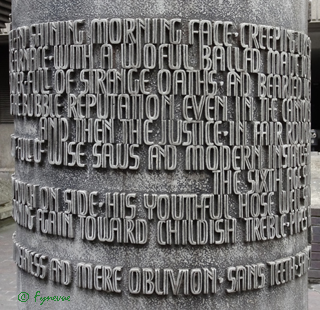 |
Shining morning face... |
| Design, images and text compiled by ©
Fynevue. Page last updated
Feb 2016 revision.
Checked June 2024. All logos and trade marks are the property of their respective owners and are used on the Light Straw site(s) for review only. Students and researchers are recommended to make their own independent enquiries as to the accuracy of the information contained therein. |