 |
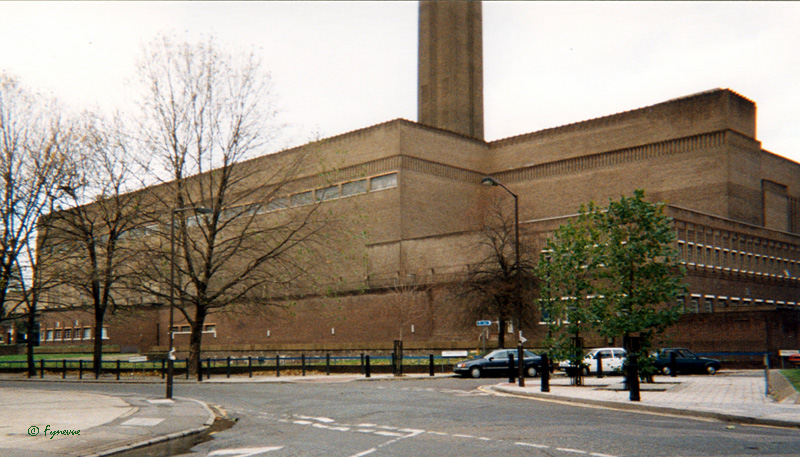
This was Bankside the disused 1960s power station in Southwark. |
Electricity generation was initially carried out by small power plants of multiple ownership serving the demands of local areas. The London Power Company was formed in 1925 with the aim of consolidation by building a small number of very large power stations and to sell the electricity to anyone who wanted it.
History of Bankside Power Station
The original Bankside power station dates from the late 19th century and was coal-fired. During the life of the plant, electricity was generated by the City of London Electric Light Company (CLELC), later part of the London Electric Supply Corporation, and in more recent times the London Electricity Board (LEB). The Electricity Act of 1947 nationalised the industry and created just 12 area boards from the existing proliferation of power supply and distribution companies. Thus the London Electricity Board (LEB) took over responsibility for Bankside and a new oil-fired plant was commissioned.
The (new) Bankside Power Station was designed and constructed in two phases between 1947 and 1963 to a design by Sir Giles Gilbert Scott. Its main features were:
|
Looking Back
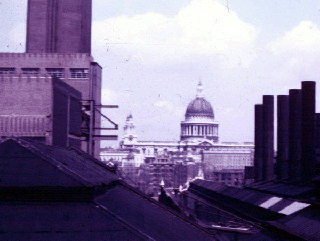 |
Ted Prangnell, who worked for the Central Electricity Generating Board (CEGB) HQ, shares some of his memories of Bankside, London. |
Her Majesty, Queen Elizabeth II opened Bankside on 7th March 1962.
Bob Irwin worked for Head Wrightson on the Bankside Power Station in 1962-63 where they erected the smoke stacks for the new section. The stacks were made of webbed moulded steal plates (ingots) which were produced by Heads at the Eaglescliffe Foundry.
[ See Head Wrightson & Co Ltd for more details.]
The End of Generation
In the 1970s, following the construction of the super-grids (275kV-400kV), the Area Boards e.g. London Electricity Board, then took over what remained of the 132kV distribution grid. This meant that locally, power could be transmitted to wherever the demand was needed, and hence lead to the ultimate demise of many smaller stations. Equally, the existence of the super-grids allowed electricity to be generated at much larger plants and again transferred, relatively easily throughout the UK. No doubt the 1973 and 1979 oil crisis also played a part in the decision to close Bankside.
Bankside's breakers tripped permanently in 1981 and the station fell into disuse, apart from a working Switch House which still distributed electricity to the immediate area.
The Architecture
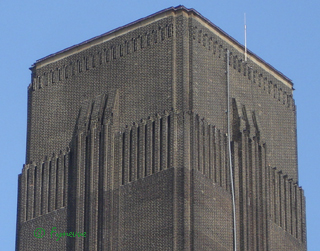 |
The former Bankside Power Station is pure art as the finely detailed brickwork pays testament to the work of (architect) Sir Giles Gilbert Scott. |
| Design, images and text compiled by ©
Fynevue. Page last updated
Feb 2016 revision.
Checked June 2024. All logos and trade marks are the property of their respective owners and are used on the Light Straw site(s) for review only. Students and researchers are recommended to make their own independent enquiries as to the accuracy of the information contained therein. |