Ted Prangnell, draughtsman for CEGB recalls...
 |
In this rare colour photo, the western part of the new Bankside Power Station and chimney is on the left. In the foreground is the roof of the old turbine hall. The old boiler house chimneys on the right harken back to the days of smoggy London. St. Paul's Cathedral can clearly be seen across the River. |
Looking back at Bankside, old and new
Ted Prangnell had a long career as a draughtsman in the electricity industry from the early 1950s, until circa 1990 when privatisation took hold. He was involved in the planning, design, and improvement of many systems within plants throughout the UK, including Bankside. Here he recalls various aspects of the site.
Photos
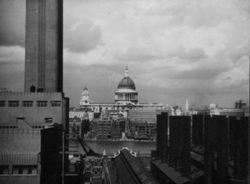 |
The centre foreground is the roof of the old Turbine Hall. |
 |
The old Boiler House with central coal bunkers. Note the coal loading chute/conveyor on the right. |
The problem with the new Bankside Power Station was its emissions. Whilst it might have been forward thinking to situate an electricity generating source right in the centre of where it was most needed, we were receiving complaints from the Dean of St. Paul's, as the cathedral was inconveniently situated downwind from the prevailing smoke. I drew a physical illustration of elevations to show how the flume of our smoke rose up and drifted across the Thames to pass well above the dome of the cathedral. This did not convince, nor did it satisfy, the Dean!
In those days a pair of Kestrels nested (despite the smoke) on an upper ledge of the Power Station stack. An exhaust gas washing plant was installed to remove the harmful sulphur. This only made matters worse, because it cooled the exhaust gases and caused them to sink instead of rise. Sometimes smoke would virtually crawl down and around the chimney to ground level, creating an unpleasant fog. It would also carry far across the River to form a fog there, and in the City!
Whether this was the sole cause of the station's demise I know not, but in response to the Clean Air Act 1956, one of my tasks was to draw a Ringelmann Chart (new to the electricity industry) from calculated dimensions. I then had to reduce these figures to a suitable scale so that I could get the chart to fit on my drawing board. The result was reduced still considerably further, and printed to be used as the official CEGB smoke density measuring card/device. The Ringlemann Chart is widely used today, though in a somewhat more sophisticated form, influenced by modern technology.
[Note: A Ringelmann Chart is used to define dark smoke. The chart has five shades of grey with 0 being clear and 5 being black. Smoke is considered 'dark' if it has a shade of 2 or darker. You can find the Ringelmann chart in British Standard BS2742C: 1957]
Bob Irwin worked for Head Wrightson on the Bankside Power Station in 1962-63 where they erected the smoke stacks for the new section. The stacks were made of webbed moulded steal plates (ingots) which were produced by Heads at the Eaglescliffe Foundry.
The District Heating Scheme
There was another aspect of Bankside about which I wonder what happened. That was the City of London District Heating Scheme, which utilised hot Condensate Cooling Water as a heating medium for properties across the River.
Quote from 'Power into Art', Karl Sabbagh 2000: "Around the base of the chimney tower was an extension that had been added later as part of a district heating scheme. Herzog and de Meuron decided to remove that structure."
CEGB Research
We carried out quite a lot of research work to improve the efficiency of C W (Cooling Water) flow through the system, using Hydraulic Gradient Charts, introducing gyratory flow circular pump houses, and even sloped cooling tower pond floors to add natural momentum to the flow. We could increase the efficiency by approximately 5%, but this had to be weighed against extra construction costs and other factors.
The CEGB had a computer in the 1960s. It was housed in one of the old warehouses in Sumner Street (it was that big!). This was used to calculate stress contours in turbine blades. It was not able to plot the curves, we had to do that by hand from node points on print-outs of masses of calculations from FEMG (Finite Element Mesh Grid). I think the engineer in charge of all this was a Dr Hodges.
With thanks to Ted Prangnell of BEA, CEA and CEGB to 1970, NZ Electricity 1970 1974, APC/CEGB Dungeness B 1977 to 1989.
| Design, images and text compiled by ©
Fynevue. Page last updated
Feb 2016 revision.
Checked June 2024. All logos and trade marks are the property of their respective owners and are used on the Light Straw site(s) for review only. Students and researchers are recommended to make their own independent enquiries as to the accuracy of the information contained therein. |